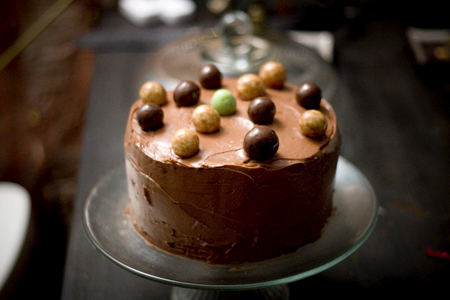
Today is Bench's birthday! Saturday was the wonderful A's birthday! If I've ever had a better reason for baking a cake, I can't think of it! (Okay, so, maybe there was ALSO the tiniest bit of an ulterior motive--I got my hands on the
Baked cookbook the second it came out, and have been dying--DYING--to take it for a test drive.) I floated the idea past Bench, with the proviso that he select the cake that I would attempt. Clever lad that he is, he accepted the challenge readily. After much deliberation, the decision was made, and the Malted Milk Cake gauntlet was thrown.
A few notes on the cake itself: the boys from Baked are very careful to tell you that white cakes are very delicate (something I did not actually know, having not ever made a white cake before. Yes, I know.), and that freezing the layers for a spell before frosting them might be a good idea. Seeing how enthusiastically the cake stuck itself to the parchment, the pans, the COOLING RACK (resulting in some rather nasty-looking divots in what became the middle layer--thank goodness frosting hides most ills), it seemed like an extremely sensible idea. I recommend it highly, as these cakes are fragile little buggers before they've had a bit of a chill. I personally decided to be an extremist and freeze them overnight, moving them to the refrigerator the next morning.
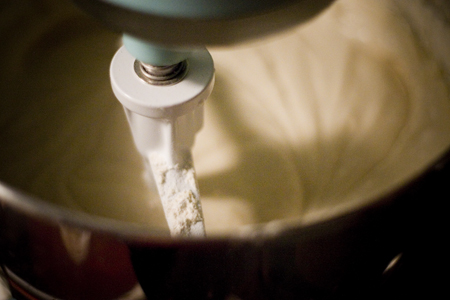
Another thing that the boys from Baked recommend is that you level off each layer of cake with a knife before assembling the cake; I'm going to come out and say that unless the workings of your inner ear could double as a level, you should probably skip that part. Seriously. I considered trying it and then remembered what happens when I try to split english muffins--let's just say that the problem would be considerably worse by the time I finished. I
did take a serrated knife to the sides, just to even them out, but you can skip that part, too, unless it would bring you personal satisfaction. My feeling is: if you're baking a cake for someone and they call you out on aesthetics, they are clearly missing the point of your labor of love and you should probably just keep it for yourself. Or make them wear it as a hat. Whatever.
The frosting was quite fun, in that it was my first stab at buttercream in, oh, let's say, ten years. Thank goodness I'd had some recent exposure to Good Eats' episode on the stuff; thanks to the magic of Alton Brown, I knew more or less what to expect, and had in my back pocket the best advice you'll ever hear about buttercream: add the butter one piece at a time, waiting for it to incorporate completely before adding the next piece. It is time consuming, but totally worth it, as you walk out with a gorgeous, silky frosting (though, really, anything with a full pound of chocolate in it is going to be pretty splendid no matter how you slice it).
Despite the profusion of chocolate, I will admit: this was not my favorite frosting recipe (I have now confirmed what I have long suspected--I am a cream cheese frosting kind of girl). It worked tremendously well with the cake, however, as the robust, not-too-sweet density of the frosting was a perfect foil for the delicate dreaminess of the cake. As someone who typically regards cake as a vehicle for frosting, it was definitely a new experience to be more excited by the cake itself.
Frosting aside (and really, there was nothing
wrong with it; it just wasn't my cup of tea), I still count the whole endeavor as a success: not only was it it was my first white cake (and my first triple-layer cake!), but it was a tremendous excuse to have a couple of my favorite people over, drink sauternes and anything else we could get our hands on, and determine that suspenders are better than xylophones. And at the end of the day, isn't that the whole point of baking? Win!
Malted milk cakeExcerpted from Baked, the cookbook. It is awesome and you should go buy it immediately, because this recipe is just the beginning of its amazingness. You should also try their chocolate babka if you ever make it to the bakery itself. Or a cinnamon chip scone. Trust me.For the cake: 2 1/4 cups cake flour
3/4 cup all-purpose flour
1 cup malted-milk powder
1 tablespoon baking powder
1/4 teaspoon baking soda
3/4 teaspoon salt
1/4 teaspoon freshly grated nutmeg
1 stick unsalted butter, at room temperature
1/2 cup solid vegetable shortening, at room temperature
2 cups sugar
1 tablespoon pure vanilla extract
2 cups ice water
4 large egg whites, at room temperature
For the frosting: 10 ounces bittersweet chocolate, finely chopped
10 ounces milk chocolate, finely chopped
1 3/4 cups heavy cream
3 tablespoons light corn syrup
4 sticks (1 pound) unsalted butter, cut into 1-inch chunks, softened
- MAKE THE CAKE: Preheat the oven to 325°. Butter and flour three 8-inch cake pans and line the bottoms with parchment paper. In a large bowl, whisk the flours with the malt powder, baking powder, baking soda, salt and nutmeg.
- In the bowl of a standing electric mixer fitted with a paddle, beat the butter with the shortening until creamy. Add the sugar and vanilla and beat at medium speed until fluffy, about 3 minutes. Beat in the dry ingredients in 3 batches at low speed, alternating with the ice water, occasionally scraping down the side of the bowl.
- In a clean bowl, beat the egg whites at medium-high speed until soft peaks form. Fold the egg whites into the batter. Divide the batter between the pans, spreading it evenly, and bake the cakes for 40 to 45 minutes until a toothpick inserted into the center comes out clean. Let the cakes cool in the pans for 20 minutes, then invert them onto a rack (note: it might be worth putting a piece of parchment paper on the rack first, otherwise you might lose a bit of the cake to the grid of the rack, as I did) and let cool completely. Peel off the parchment. (A tip: Wrap the individual layers in foil and freeze them for at least an hour before even attempting to frost them. You will not regret this.)
- MEANWHILE, MAKE THE FROSTING: Place the chocolate in a large bowl. In a small saucepan, bring the cream to a boil, then remove from heat. Add the corn syrup; immediately pour the mixture over the chocolate. Let stand for 2 to 3 minutes, until the chocolate has melted, then whisk until smooth. Let cool to room temperature.
- Transfer the mixture to the bowl of a standing electric mixer fitted with a wire whisk. Gradually beat in the butter at medium speed, a few chunks at a time, and beat until thoroughly incorporated between additions. The frosting should be smooth and silky. Refrigerate the frosting just until it is thick enough to hold its shape, 10 to 15 minutes.
- Place one cake layer on a serving platter and spread 1 1/4 cups of the frosting over the top in an even layer. Repeat to form 2 more layers. Spread a thin layer of frosting over the side of the cake and refrigerate briefly until firm. Frost the side with the remaining frosting. Garnish the cake with malted-milk balls and refrigerate briefly to firm up the frosting before serving.
- Remember to share. You will be sorely tempted to keep it all for yourself.


 Posts
Posts

